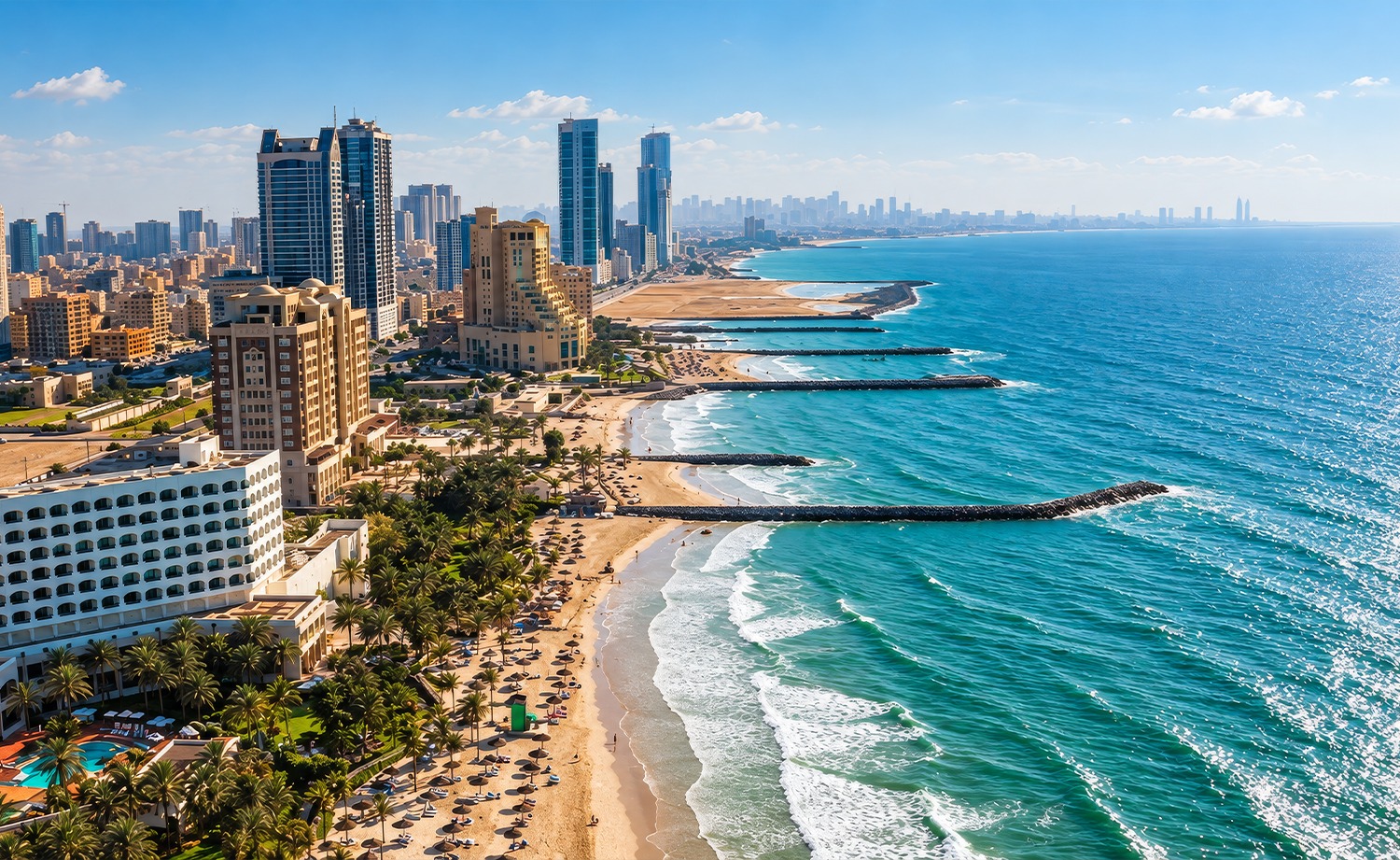
Dubai’s residential prices rose by roughly 60% between 2022 and early 2025, and Fitch Ratings now expects a moderate correction. Thirty minutes up the coast, Ajman is recording the strongest results in its history. By November 2025, the emirate’s property transactions for the year had already exceeded AED 25.3 billion, surpassing the AED 20.5 billion recorded across the whole of 2024.
Ajman is not a substitute for Dubai, and the two markets serve different buyers. For a growing number of homebuyers and investors, however, the figures increasingly favour the smaller emirate.
1. A significantly lower entry price
Average sale prices stand at around AED 350 per square foot in Ajman Downtown and AED 360 in Emirates City, rising to approximately AED 1,141 in waterfront Al Zorah. Dubai’s citywide average is about AED 1,658 per square foot.
In practical terms, buyers in Dubai pay four to five times more per square foot than in Ajman’s main residential districts (our calculation). Even Al Zorah, Ajman’s most premium neighbourhood, remains below the Dubai average.
2. More living space for the same budget
At these averages, AED 1 million secures roughly 2,850 sq ft in Ajman Downtown, compared with about 600 sq ft at Dubai’s average price (our calculation).
One brokerage illustrates the difference. The budget for a 350–450 sq ft studio in JVC or Arjan can buy a two-bedroom apartment of 1,000–1,300 sq ft in Al Nuaimiya, Al Rashidiya or Ajman Downtown.
3. Competitive rental returns on a smaller investment
Rental yield measures annual rent as a percentage of the purchase price. Ajman’s yields are not dramatically higher than those in Dubai’s strongest areas. The advantage is that they are achieved with considerably less capital.
Bayut recorded 2025 yields of 7.90% in Ajman Downtown, 7.85% in Emirates City and 9.27% in Garden City. In Dubai, Discovery Gardens led the affordable segment at 9.06% in the first half of 2026, while Al Furjan recorded 7.69% in the mid-market segment.
4. Lower registration fees
Ajman’s transfer fee is paid by the buyer. It is 3% (minimum AED 3,000) for foreign buyers and 2% (minimum AED 2,500) for UAE and GCC nationals. Dubai’s equivalent fee is typically 4%.
On a AED 700,000 apartment, a foreign buyer would pay AED 21,000 in Ajman, against AED 28,000 at the Dubai rate (our calculation).
5. Consistent market growth
Ajman recorded 15,125 transactions worth more than AED 20.5 billion in 2024, a 21% increase on 2023.
In 2025, transactions reached AED 25.3 billion by November, and December added a further AED 2.78 billion. That brings the annual total to approximately AED 28 billion, growth of around 37% year on year (our calculation).
6. Greater value under the Golden Visa
The UAE’s 10-year Golden Visa is available to buyers of property worth at least AED 2 million in any emirate. This includes off-plan units bought from approved developers.
In Dubai, that amount typically secures a mid-sized apartment. In Ajman, it can fund a large family home or, where regulations permit, more than one unit. Investors are already using this route. In 2025, Ajman issued 1,834 Golden Visa property valuations worth a combined AED 4.94 billion.
7. Lower exposure to Dubai’s supply peak
Dubai faces a significant volume of new completions. Fitch expects deliveries to peak at around 120,000 units in 2026, four times the 2024 level, although it does not anticipate price declines beyond 15%. Additional supply typically increases competition for both buyers and tenants.
Ajman is not immune: new project registrations rose 121% in 2025. Choosing the right project and location remains essential in both markets.
8. Improving connectivity
Commuting between the two emirates remains Ajman’s main drawback, and it is now a federal priority. In 2026, the UAE Infrastructure and Housing Council reviewed a AED 6 billion federal highway and a public transport plan for the Dubai–Sharjah–Ajman corridor.
Etihad Rail has also tendered a section to Hamriyah in Ajman. Once built, it would connect the emirate to the national passenger rail network.
9. Lower deposits and active lending
Lower prices reduce the upfront investment. At the same deposit percentage, a AED 500,000 apartment requires one-third of the cash needed for a AED 1.5 million unit (our calculation).
Lending activity remains healthy. Ajman recorded 969 mortgage transactions worth more than AED 1.88 billion in the first half of 2026.
10. A new generation of master-planned communities
Ajman’s new supply differs markedly from its older housing stock. Tiger Properties has launched Tiger Downtown Ajman in Al Alia, a $10 billion lagoon-front community with 5 million sq m of built-up area.
Ownership is open to all nationalities, and the first phase offers payment plans of up to five years. That phase, Orchid Towers, is scheduled for completion in Q4 2028.
What the numbers also show
A balanced assessment must also consider Ajman’s limitations.
- Resale demand. Dubai’s pool of buyers is far larger, which makes properties easier to sell. Dubai recorded around 86,000 sales in the first half of 2026, compared with 5,435 in Ajman.
- Capital growth. According to Colliers, Ajman prices have grown by about 6% a year since 2018, well below Dubai’s recent gains.
- Recent slowdown. Ajman’s transactions totalled AED 10.8 billion in the first half of 2026, down from AED 12.4 billion a year earlier. Dubai also slowed over the same period, which points to a regional trend rather than an Ajman-specific one.
- Variable yields. Returns differ considerably between buildings. Global Property Guide, which uses advertised rents and prices, places Ajman’s average gross yield at 4.95%.
Conclusion
Ajman does not outperform Dubai on every measure. Dubai remains the larger market, with stronger resale demand and a better record of price growth.
Ajman’s case rests on value:
- significantly lower prices per square foot
- rental returns comparable to Dubai’s affordable areas
- lower fees
- a consistent record of transaction growth
For buyers who put space, rental income and the size of their initial investment ahead of a Dubai address, the price gap is now difficult to overlook. Three factors will decide the outcome: project quality, the developer’s track record, and how quickly new road and rail links improve the commute.